In this guide
A shift handoff is often squeezed between someone trying to leave and someone trying to begin. That pressure encourages either a long story or a very short “all good.” Neither necessarily tells the next person what needs attention. A useful handoff transfers the current state of the work: what is complete, what is open, what matters now, and who is taking the next step.
The five-field method below is an original editorial aid, not a Nordstrom form or a clinically validated communication system. Use the employer’s required channels and records first. OSHA’s hazard-identification guidance gives general support for communicating hazards and learning from incidents; it does not endorse this particular handoff format or establish the procedures at a retail location.
Field one: the task and its location
Start with a bounded subject. “The return sorting in this area” is more useful than “everything from earlier.” Identify the relevant location or approved task reference without putting customer details or confidential identifiers into an informal message. The next person should be able to tell which work the update describes and which nearby work it does not describe.
If several tasks need handoff, separate them. Combining a customer question, a stock movement, and an equipment concern into one paragraph makes it easy to attach the wrong status to the wrong task. A short line for each subject is often clearer than a chronological account of how the shift unfolded.
Field two: the last confirmed state
Say what you know happened, not what you expect happened. “These items have been checked and are awaiting the next approved step” differs from “they should be ready.” Separate completed action from attempted action. A message sent, a question raised, or a request entered may still be waiting for acknowledgment or a decision.
In a fictional handoff, one worker has asked a supervisor where a group of items should go. The answer has not arrived. The accurate state is “location decision pending,” not “items ready to move.” This distinction lets the incoming worker continue from the real checkpoint instead of repeating an uncertain assumption.
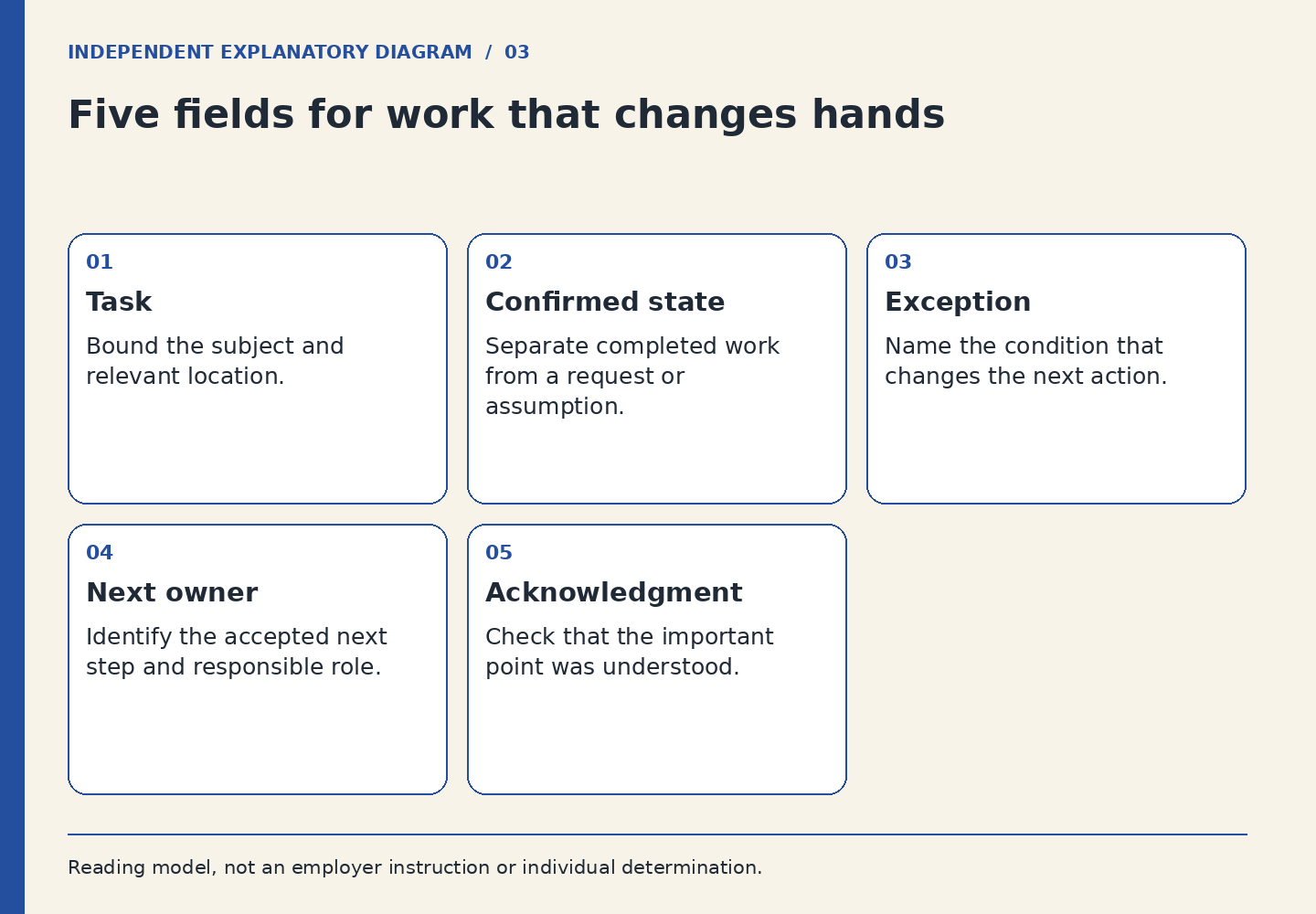
Field three: the exception that changes the next action
Lead with a safety concern or time-sensitive exception when it changes what someone should do. Do not bury a blocked route at the end of a long activity list. Describe the observable condition and the current protective arrangement, using the required channel. An immediate hazard should be addressed promptly; it should not wait simply because the formal handoff is later.
Keep interpretation separate from observation. “The device displayed this error and the task remains unfinished” is a more dependable statement than “the system lost everything.” If you do not know the cause, say so. The next person needs an honest picture of uncertainty, not a confident explanation that has never been checked.
Field four: the next action and responsible role
Name what is meant to happen next and which person or role has agreed to take it. “Someone needs to check” leaves the assignment unowned. “The area lead is deciding the location; please wait for that instruction” identifies both the pending decision and the boundary. Do not assign work to an absent coworker without the authority to do so.
If no one has accepted the next step, make that gap explicit to the responsible supervisor. Leaving a note is not the same as obtaining coverage. The goal is not to keep the departing worker indefinitely responsible for everything; it is to make the transition follow the actual staffing and handoff arrangements rather than relying on assumption.
Field five: the acknowledgment
Ask the recipient to confirm the key point in their own words, especially when a condition could be misunderstood. This can be brief: “So the location is still pending and no move has been completed?” It is an understanding check, not a memory test. A correction at this moment is more useful than a polite nod followed by duplicate or conflicting work.
Use the approved record when one is required, and do not maintain a separate personal archive of private customer or employee information. A spoken update may need a formal entry; a formal entry may still need a direct alert. Follow the channel appropriate to the urgency and subject rather than assuming one communication method is sufficient for every handoff.
Make the handoff shorter by making it clearer
Remove details that do not change the next decision. Keep the facts that do: task, last confirmed state, exception, next responsible step, and acknowledgment. The best handoff is not the one that proves how busy the departing person was. It is the one that lets the next person begin without guessing, while preserving the limits and unresolved questions that still matter.
Sources and reading boundaries
Sources checked October 7, 2026. This is a review date, not a policy effective date or an account test.
- OSHA: Hazard identification and assessment: Investigating close calls and hazards to understand underlying causes, including equipment, time, training, and supervision. The observation prompts here are original. They do not replace required reports, investigations, or formal determinations. Review basis: Official public page text reviewed.