In this guide
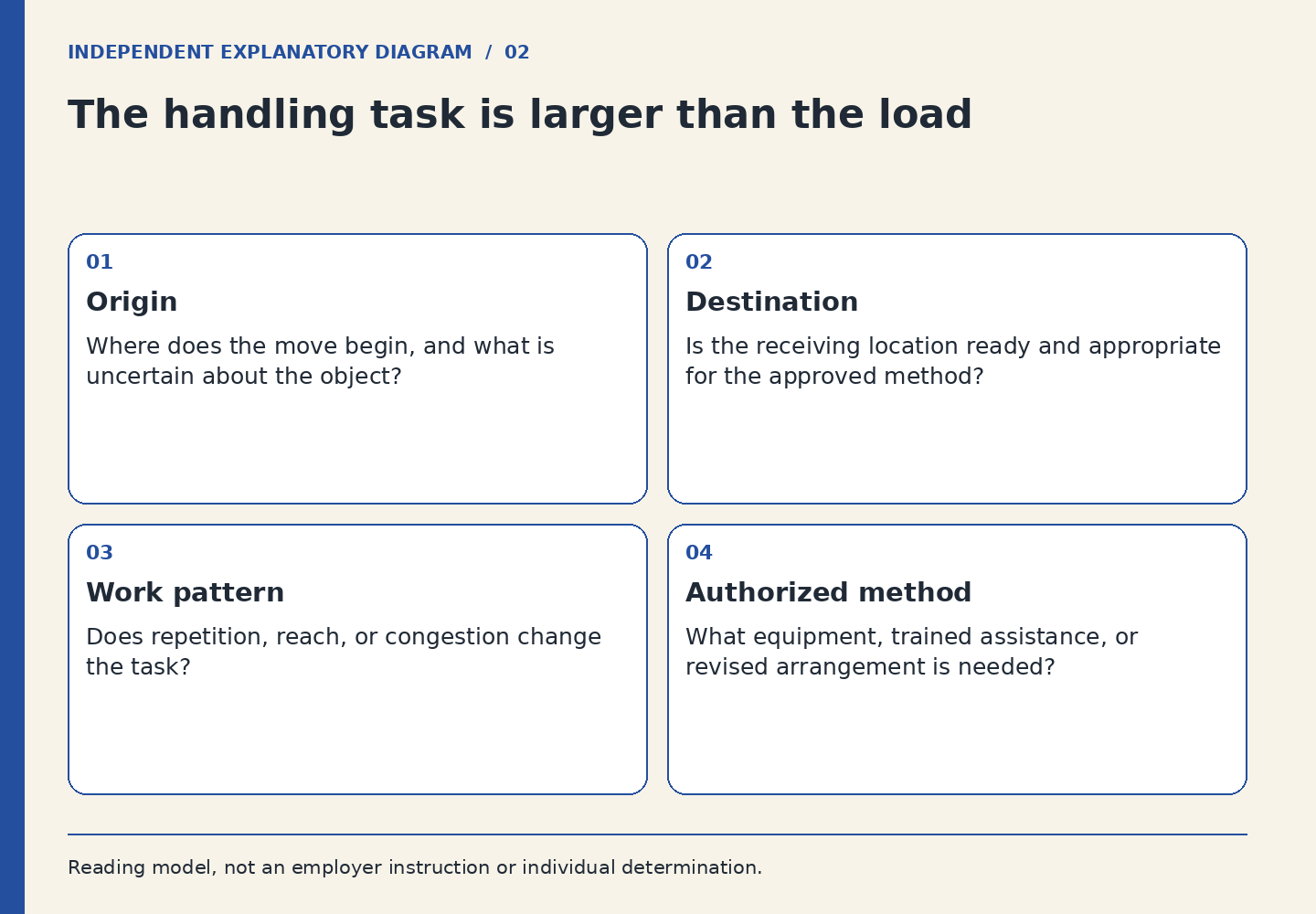
A carton’s size is only one part of a handling task. Where it starts, where it must finish, the space around it, and how often the move repeats can matter just as much. Looking only at the object encourages a narrow question: “Can I lift this?” A more useful workplace question is: “What is the approved way to move this object under these conditions?”
OSHA’s warehousing guidance identifies force, awkward posture, reaching, and repetition as relevant ergonomic factors. Its grocery guidance likewise considers task layout and handling aids. These are general sources, not Nordstrom instructions. They support looking beyond a box’s weight; they do not certify an individual lift or supply a universal weight that is safe for everyone.
Start with the two ends of the move
Before touching the load, identify where it is coming from and where it is supposed to go. Is the destination ready? Will the task involve an awkward reach, an unstable landing place, or handling the object again because the location is not prepared? A move that appears simple at the start can become difficult at the destination. Resolve the receiving arrangement before making the load your immediate problem.
For a fictional example, imagine an employee asked to move a carton from a low stack to a crowded shelf. A hasty plan considers only the carton. A better conversation includes the shelf space, the approved equipment, and whether the task should be reorganized by someone responsible for the area. The example is about preparation; it does not instruct anyone to perform that lift.
Treat missing information as a task condition
You may not know the contents, stability, or handling requirements. Do not test an uncertain load by making an abrupt effort. Use the workplace’s method for assessing it and seek help when information is missing. A coworker saying “I moved one yesterday” does not establish that today’s carton, route, or worker’s circumstances are the same.
Describe the problem concretely when you ask: “The destination is above my comfortable reach,” or “I cannot identify the approved way to move this awkward item.” That gives the responsible person something to address. You do not need to defend your strength, disclose a medical history to a group, or propose an improvised technique before asking for the task to be reviewed.
Assistance is a planned method, not a last-second rescue
An appropriate handling aid or a properly planned assisted move may be part of the approved approach. The exact choice depends on the task, equipment, and training. Do not use a powered device merely because it is nearby, and do not assume two people make an otherwise unsuitable move safe. Ask who is authorized to operate the equipment or direct the assisted handling method.
If a tool is missing or seems defective, report that condition through the appropriate route. Substituting an unsuitable tool can shift the problem rather than solve it. The practical question becomes: “What should happen to this assignment until the correct arrangement is available?” A clear temporary instruction is more useful than pressure to complete the original move somehow.
Include the repetition, not just the first attempt
A task performed once and a task repeated through a busy period are different planning situations. Tell the responsible person when the handling sequence repeats, when reach changes as a stack gets lower, or when the receiving area becomes more congested. These observations can support a review of the work arrangement rather than a narrow correction of one movement.
This publication cannot diagnose pain or assess individual physical capacity. If a task causes discomfort, injury, or another health concern, use the workplace’s reporting and care arrangements promptly and seek appropriate medical help. Do not use an article, a fitness habit, or another worker’s experience as a reason to push through a problem that needs attention.
Know what would make the plan stop applying
A load shifts, a route closes, or the intended equipment disappears. Any of those changes can invalidate the arrangement you discussed. Pause the affected task safely and ask for the plan to be reassessed. Completion pressure does not make old conditions true again. When passing the work to someone else, explain what was unresolved and which move has not been approved or completed.
The useful outcome is not confidence that every carton can be handled. It is clarity about this task’s conditions, the suitable method and support, and the limit beyond which you should not improvise. A safe-work discussion is stronger when it addresses the work system around the object rather than turning the object into a test of personal toughness.
Sources and reading boundaries
Sources checked October 7, 2026. This is a review date, not a policy effective date or an account test.
- OSHA: Warehousing hazards and solutions: Material-handling risk factors and the importance of task design, clear routes, and appropriate maintained equipment. General warehousing guidance; not a Nordstrom procedure or a determination that a particular lift or device is safe. Review basis: Official public page text reviewed.
- OSHA: Guidelines for Retail Grocery Stores: Ergonomic considerations for stocking, including reach, cart condition, and handling-space design. Grocery-industry recommendations used only for analogous handling principles. No universal lifting-weight limit or department-store rule is inferred. Review basis: Official 29-page PDF text reviewed, particularly printed pages 8–10 and 19–20.