In this guide
A close call can be easy to dismiss because the worst outcome did not happen. A falling item missed someone, a cart stopped before a collision, or a worker noticed a floor hazard just in time. The absence of an injury does not answer why the situation occurred or whether the next person will have the same chance to avoid it.
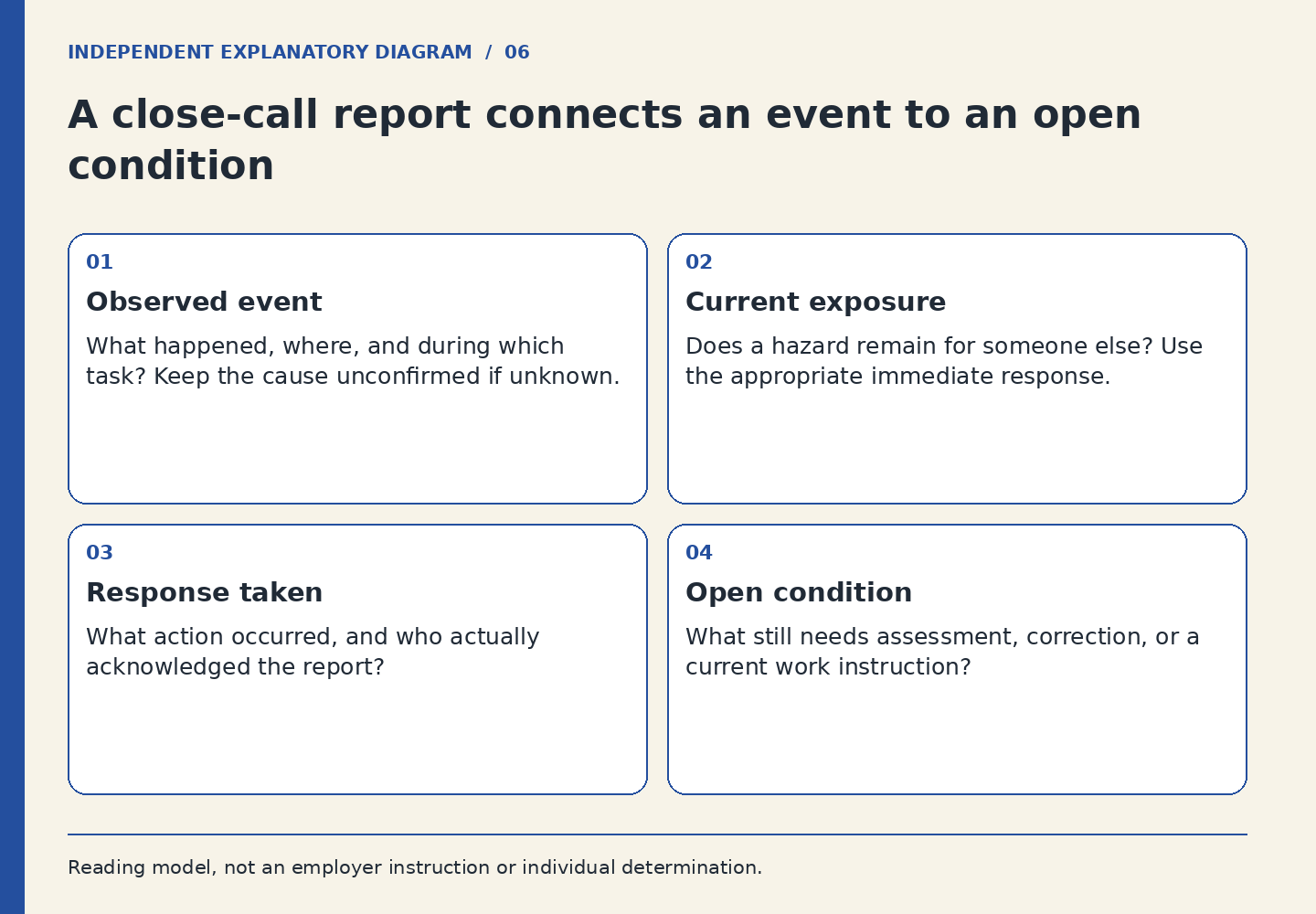
OSHA’s safety-program guidance encourages reporting hazards and close calls and investigating their underlying causes. The goal includes understanding equipment, task design, time, training, and supervision rather than stopping at individual blame. This article offers an original way to prepare a clear account. Use the workplace’s required reporting process; these prompts do not replace a report or determine legal responsibilities.
First address the present condition
If danger remains, follow the appropriate immediate protective and reporting procedure. Do not postpone a warning while polishing a written account. Do not enter a hazardous area, recreate the event, or handle damaged equipment to gather better evidence. Your first task is the safe response you are trained and authorized to make, including seeking urgent help when needed.
A near miss can coexist with an ongoing hazard. In a fictional example, a worker avoids a loose object in a passage but the object remains where someone else could encounter it. The account should not begin and end with “I did not fall.” It should include whether the condition was addressed under the procedure or still needs the responsible person’s attention.
Describe what you observed
Name the location, approximate time, task underway, and observable event using the information the approved process asks for. Keep direct observation distinct from what another person told you. “I saw an item fall from the shelf” is different from “the shelf failed.” The second statement supplies a cause that may require investigation. If the cause is unknown, leave it unknown.
Use ordinary, concrete words. Describe a cart wheel that would not turn as expected rather than writing that the equipment was “bad.” Describe a blocked area rather than saying the whole stockroom was “chaotic.” Specific observations give someone a starting point for inspection and make it easier to recognize whether a reported condition has actually changed.
Explain the exposure without dramatizing it
Identify who or what could have been affected at the relevant level of detail. The report may need names through a secure workplace process, but an informal planning note should not become a private dossier about coworkers or customers. Do not add a guessed injury, a dramatic hypothetical, or an allegation of intent simply to make the report sound more serious.
A factual description can still communicate urgency. “The obstruction remains in a route people are using” is enough to explain why action is needed. Do not downgrade the issue because the previous person managed to avoid it, and do not promise that a temporary measure makes the condition safe. The responsible person needs to assess the actual exposure and appropriate control.
Record the immediate response and what remains open
State which action you took, whom you notified, and what was confirmed. A message sent is not necessarily a report received. A warning placed is not necessarily a repair completed. If the process provides a reference or acknowledgment, use it appropriately. If you do not know whether the matter has been accepted, ask through the relevant route rather than assuming silence means completion.
Keep the unresolved question narrow: “Who will assess the damaged equipment?” or “What is the approved route while this area is unavailable?” The question should help the work proceed safely without requiring you to conduct the investigation yourself. Do not repair equipment, test a hazard, or invent a replacement procedure simply to produce a satisfying conclusion.
Follow up on conditions, not rumors
When appropriate under the workplace process, ask what changed and what workers need to know. A repair, revised arrangement, or new instruction may affect the next shift. If the same condition recurs, report the recurrence with its own observations and connect it to the earlier report where the approved system allows. Repetition can reveal a work-design problem that a one-time cleanup did not solve.
Do not treat an informal explanation from a coworker as the final finding. Investigations may take time and may include private information that should not be shared widely. What you need for your own work is the current instruction, the relevant control, and the route for raising an unresolved concern.
A good account makes the event usable for prevention. It says what happened, what is happening now, and which condition still needs attention. It neither minimizes the close call nor turns it into a story about a careless person. That leaves room for the responsible people to make a real change to the work.
Sources and reading boundaries
Sources checked October 7, 2026. This is a review date, not a policy effective date or an account test.
- OSHA: Hazard identification and assessment: Investigating close calls and hazards to understand underlying causes, including equipment, time, training, and supervision. The observation prompts here are original. They do not replace required reports, investigations, or formal determinations. Review basis: Official public page text reviewed.
- OSHA: Worker participation: Worker involvement, reporting concerns, and access to safety information. General program guidance. No claim about a specific employer’s reporting system, deadlines, or response. Review basis: Official public page text reviewed.