In this guide
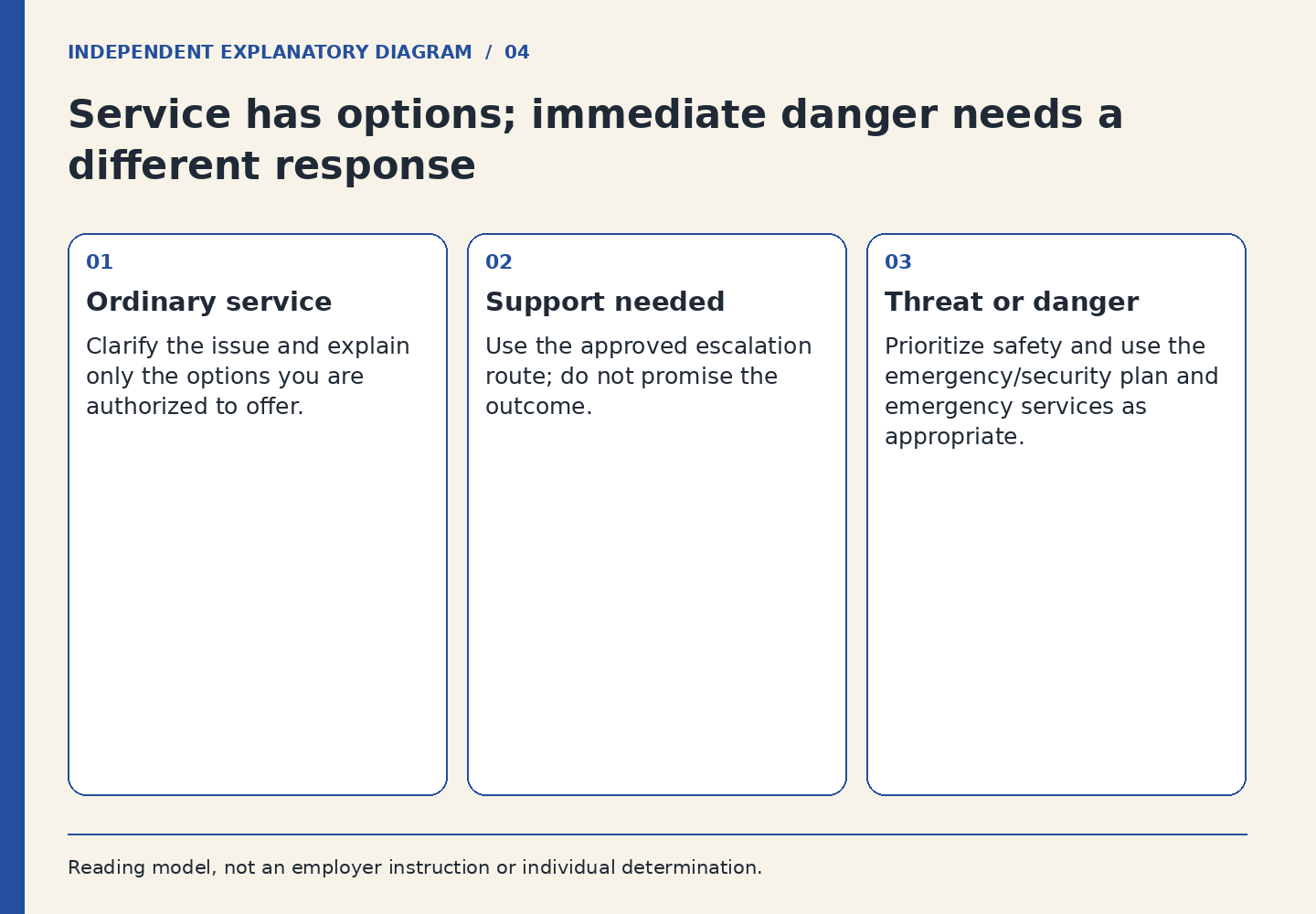
A customer may be disappointed, impatient, or confused without posing a threat. A worker can often help by clarifying the problem and the options they are actually authorized to offer. But a conversation that becomes threatening is a different situation. Good service does not require a worker to win an argument, absorb abuse indefinitely, or remain in a place that feels unsafe while trying one more phrase.
NIOSH’s retail guidance recommends following workplace violence training, reporting threats, avoiding arguments with threatening or violent customers, and not confronting or chasing people during a smash-and-grab. Those are general boundaries, not a substitute for a location’s security plan. No wording in this article guarantees that another person will calm down or authorizes a worker to act as security.
Begin with the service issue when it is safe to do so
Use a plain question about the immediate problem: “Which part would you like me to check?” Reflect only what you can verify. “You were expecting a different result” may accurately describe the concern; promising an exception you cannot approve does not. Keep the exchange focused on the next available step rather than debating who is right about every part of the experience.
In a fictional example, a shopper is upset that an option is unavailable. The employee can explain the information they have and ask an authorized colleague to review any unresolved question. That does not mean promising the colleague will reverse the answer. A useful service statement is specific about the action you can take and honest about what remains someone else’s decision.
Use a boundary you can actually maintain
A short, calm statement can name the limit and available support: “I can ask the person responsible to review this.” Use wording that fits your training and the situation. Avoid threats, sarcasm, personal judgments, or a challenge to the customer’s status. You are trying to communicate the process, not establish dominance or secure an admission that the customer behaved badly.
Do not improvise a universal “three warnings” rule from an online article. Some situations require immediate disengagement or urgent help; others remain ordinary service conversations. The appropriate response depends on observable behavior, your training, and the actual workplace plan. Evaluate what is happening, not a person’s appearance, disability, accent, age, or other identity characteristics.
Recognize when ordinary dialogue is no longer the task
Threats, attempts to harm someone, or other indications of immediate danger call for the relevant emergency and security arrangements. Move toward safety when appropriate, seek trained assistance, and contact emergency services when needed. Do not wait to complete a script, fill in a worksheet, or finish explaining the policy. Protecting people takes precedence over resolving the original service request.
Do not chase someone, block an exit, grab a person, or attempt a physical intervention on the basis of this guide. Do not retrieve merchandise to prove a point. Your employer’s training and the emergency situation govern what actions are appropriate. If you do not know how to summon help from your work area, ask before a difficult incident occurs.
Bring in help without turning the handoff into a spectacle
For a non-emergency escalation, give the authorized colleague the essential service question and the current state. Avoid a loud retelling in front of a crowd or a judgmental label such as “impossible customer.” If safety-relevant behavior occurred, describe it accurately through the appropriate channel. A factual account helps the next person understand both the service issue and the boundary.
If a coworker is involved, support them within the plan rather than surrounding the customer or adding competing instructions. Extra voices can make a handoff less clear. The appropriate support may be notifying the designated lead, moving other people away under the plan, or providing an accurate account afterward. Do not invent tactical interventions from a general publication.
Report and recover after the immediate situation
NIOSH describes workplace violence as including threats and verbal abuse as well as physical assault. An incident does not have to cause a visible injury before it is worth raising through the reporting process. Record observations promptly and accurately in the approved place. Do not post footage, customer information, or coworker details publicly as a way to process what happened.
Ask about available workplace support and seek appropriate professional care when needed. A worker’s response to a frightening event is not a measure of retail competence. The practical lesson to carry forward is a clear boundary: ordinary service can include listening and authorized options; safety concerns require the trained support and response that the situation calls for.
Sources and reading boundaries
Sources checked October 7, 2026. This is a review date, not a policy effective date or an account test.
- NIOSH: Help for the Holidays: Preventing fatigue, violence, and stress in retail: Retail violence-prevention boundaries: follow training, report threats, avoid arguing with threatening customers, and do not chase smash-and-grab offenders. December 2023 general retail discussion; no local security procedure or guarantee that dialogue can prevent violence. Review basis: Official public page text reviewed.
- NIOSH: Violence and work: Workplace violence includes threats and abuse as well as physical assault; effects can be physical and psychological. December 2024 overview. Historical national statistics are deliberately not used to predict individual stores. Review basis: Official public page text reviewed.